
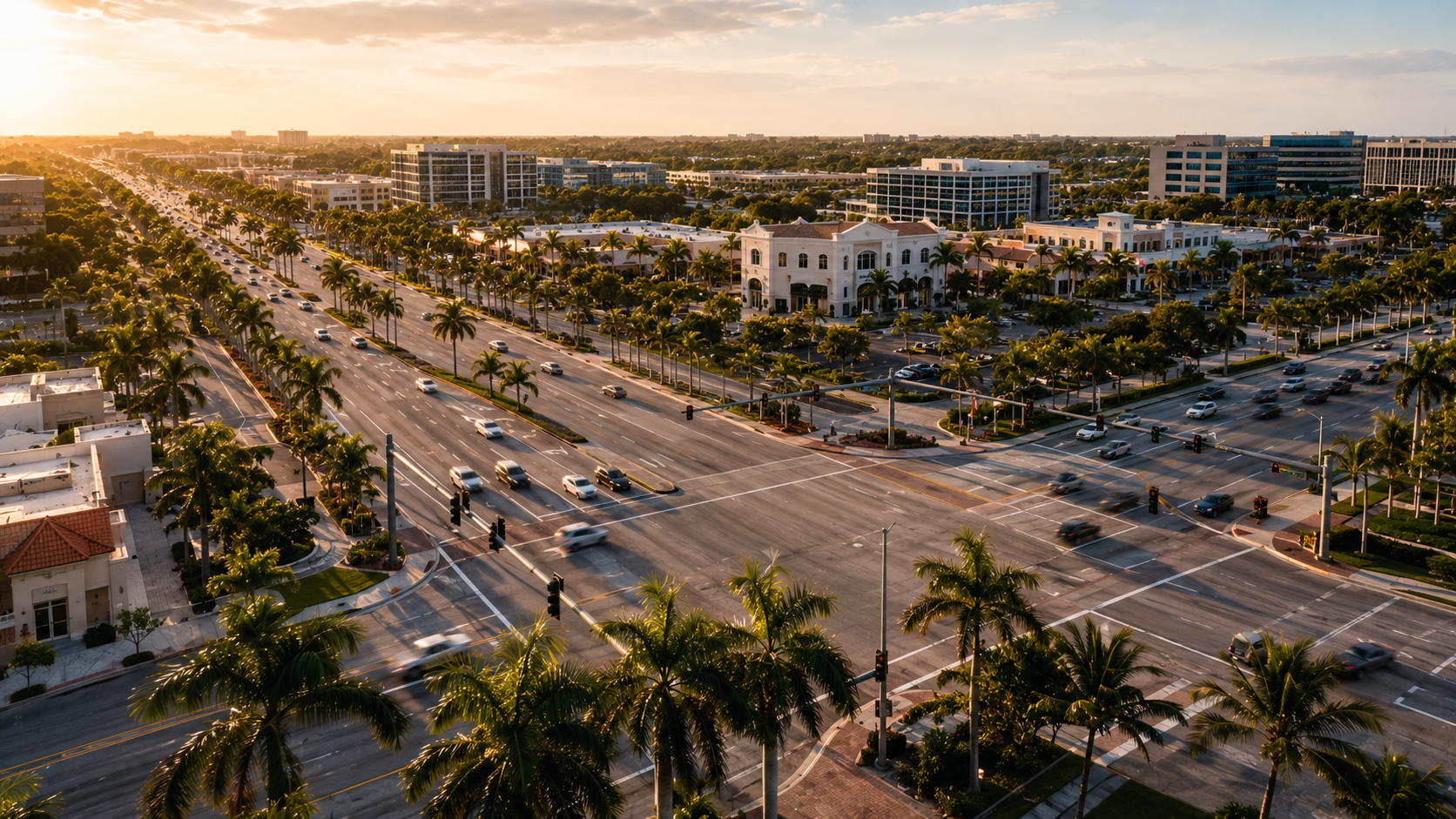
TL;DR: Boca Raton’s most dangerous intersections sit on Glades Road, Yamato Road, and Federal Highway, where high-speed cross traffic and dense retail drive a disproportionate share of Palm Beach County crash claims.
Boca Raton’s most dangerous intersections share a small set of common features: high-volume cross traffic, dense surrounding retail or office density, complicated turn movements, and the perfect mix of impatient locals and unfamiliar visitors moving through them at peak hours. Glades Road and State Road 7, Federal Highway and Glades Road, Yamato Road and Military Trail, and Palmetto Park Road and Powerline Road appear repeatedly in injury claims handled across Palm Beach County, and the patterns of those crashes are remarkably consistent. Knowing which intersections matter is the first step in either avoiding the next crash or building the strongest possible claim if you have already been in one.
Why Boca’s Intersections Generate So Many Claims
Palm Beach County’s crash data, which is publicly accessible through the Florida Department of Highway Safety and Motor Vehicles crash reports portal, shows a clustering of incidents at signalized intersections where east-west arterials meet north-south corridors. Boca Raton is built on that grid. The east-west arterials (Glades Road, Yamato Road, Palmetto Park Road, Camino Real, Spanish River Boulevard) carry tens of thousands of daily trips between I-95 and the coast. The north-south corridors (Federal Highway, Dixie Highway, Military Trail, Powerline Road, Saint Andrews Boulevard) carry through-traffic moving between Delray Beach, Boynton Beach, and the south county line. Where they cross is where the crashes happen.
Three factors compound the volume. First, retail density at most of these intersections pulls drivers in and out of shopping plazas with sudden turn movements. Second, snowbird and tourist season (November through April) brings drivers who are unfamiliar with the signal timing, the lane configurations, and the local driving culture. Third, ride-hail and food delivery drivers are concentrated at these intersections during evening peak, often making last-second navigation decisions that drivers behind them do not anticipate.
The Intersections That Show Up Most Often in Boca Crash Claims
Glades Road and State Road 7 (US-441)
On Boca’s western edge, Glades Road meets State Road 7 (US-441) at one of the busiest signalized intersections in west Palm Beach County. The crossing serves dense west Boca retail, big-box centers, and the residential growth pushing further west. Volume, complicated turn movements at the strip-mall driveways within a half-mile of the light, and a steady stream of unfamiliar drivers from western communities produce a consistent pattern of side-impact and rear-end collisions.
Yamato Road and Military Trail
Yamato carries a heavy mix of commuter and commercial traffic between I-95 and the airport corridor, while Military Trail connects the office parks south of Yamato to the residential neighborhoods north. The combination of high-speed through-movement on Yamato and shorter-distance turning traffic on Military Trail produces broadside collisions that tend to involve more serious injuries because of the speed differential. Truck involvement is also higher here than at most Boca intersections.
Federal Highway and Glades Road
This intersection is the gateway between east Boca and the I-95 corridor. Federal Highway (US-1) carries the regional north-south flow between Delray Beach and Pompano Beach, while Glades Road carries the east-west flow from I-95 to the coast. Heavy commercial development on all four corners, complex left-turn movements at peak hours, and a steady volume of through-drivers heading for downtown, the beach, or the freeway make this one of the busiest signalized intersections in the city and a recurring location in injury claims.
Palmetto Park Road and Powerline Road
Palmetto Park Road meets Powerline Road in west Boca’s mixed residential-and-commercial belt. The intersection has a documented pattern of red-light running incidents, particularly during the morning and evening commute peaks, which translates directly into serious T-bone collisions when impatient drivers push through on stale yellow or fresh red. Pair the signal-phase issue with the volume of school-zone and neighborhood traffic feeding the intersection and the claim pattern becomes consistent.
What Makes These Intersection Crashes Different in a Claim
Intersection collisions in Florida bring a specific set of legal questions that simpler rear-end or single-vehicle crashes do not. Liability is almost always contested. Both drivers typically claim they had the green light, the right of way, or the protected turn arrow. Witness statements often diverge. Surveillance footage from nearby businesses becomes essential and disappears quickly. Phone records, infotainment system data, and signal timing reports can become central evidence. Comparative negligence under Florida law means that even a partially at-fault driver can recover, but the percentage of fault directly determines the recovery amount, so the investigation matters.
The early steps after an intersection crash are what separate strong claims from weak ones. Calling 911, requesting a Florida Traffic Crash Report (long form, not short form), photographing the scene from multiple angles including the position of both signals, identifying any witnesses, and noting the time and location precisely all become part of the file. Surveillance footage from adjacent businesses is often the single most decisive piece of evidence, and it is typically overwritten within seven to thirty days. The window to preserve it is short.
How Our Firm Approaches These Cases
Intersection injury cases require investigative depth that goes beyond the police report. Our personal injury practice routinely deploys accident reconstruction experts, signal timing analysts, and surveillance preservation requests within the first 72 hours of taking a case. We know which businesses have cameras pointed at which corners, which Boca Raton Police Department officers will respond to records requests promptly, and which surveillance vendors hold which retention periods.
The same investigative approach applies to Delray Beach, Boynton Beach, and West Palm Beach intersection cases, where many of the same patterns repeat with different landmarks. Our experienced Boca Raton car accident lawyers have handled these cases throughout South Florida, and the playbook adapts to the specific intersection but always starts with the same early preservation steps.
If You Have Been Hurt at One of These Intersections
The most important variable in your claim is how quickly the case investigation starts. Surveillance footage, signal data, witness availability, and physical evidence at the scene all degrade fast. The 14-day PIP rule means medical treatment also has to begin promptly. Pairing both timelines under experienced counsel is what produces the strongest outcome.
If you were injured at Glades and State Road 7, Yamato and Military, Federal and Glades, Palmetto Park and Powerline, or any other Boca Raton intersection where the other driver is disputing fault, request a consultation with our firm. The earlier we can begin preservation work, the better the case becomes.
Frequently Asked Questions
Which Boca Raton intersections produce the most crash claims?
Glades Road at State Road 7 (US-441), Federal Highway at Glades Road, Yamato Road at Military Trail, and Palmetto Park Road at Powerline Road appear most consistently in our case files. Each combines high traffic volume with complex turn movements, retail density, or signal-running patterns that drive the claim rate above the city average.
How quickly does surveillance footage disappear after a Boca crash?
Retention periods vary widely. Many retail and restaurant cameras overwrite within seven days. Office building systems may hold thirty days. ATM cameras can retain longer. The reliable rule is that footage preservation requests should go out within 72 hours of the crash to have any meaningful chance of capture.
What evidence matters most in an intersection-crash injury claim?
The Florida Traffic Crash Report, photographs of both vehicles and both signal heads at the time of the crash, witness statements with contact information, signal timing reports from the local traffic authority, and surveillance footage from adjacent businesses all carry weight. Phone records and infotainment data become important when distracted driving is suspected.
How does Florida’s comparative negligence rule affect intersection cases?
Florida applies modified comparative negligence with a 50% bar. If you are found more than 50% at fault, recovery is barred. If you are 50% or less at fault, your recovery is reduced by your percentage of fault. In intersection cases where liability is split, this calculation can dramatically change the value of the claim.
What should I do at the scene of a Boca Raton intersection crash?
Call 911, request a long-form Florida Traffic Crash Report, photograph everything including the signals and lane configurations, identify witnesses by name and phone number, and avoid admitting fault to anyone. Once safe, seek medical evaluation within the 14-day PIP window even if symptoms feel mild.
Can I still recover damages if the other driver also claims I ran the light?
Yes, in many cases. Florida’s comparative negligence rule allows recovery when fault is shared, and intersection cases often resolve based on physical evidence rather than competing driver statements. Surveillance footage, signal data, accident reconstruction, and witness corroboration can establish that the other driver bore the majority of fault.