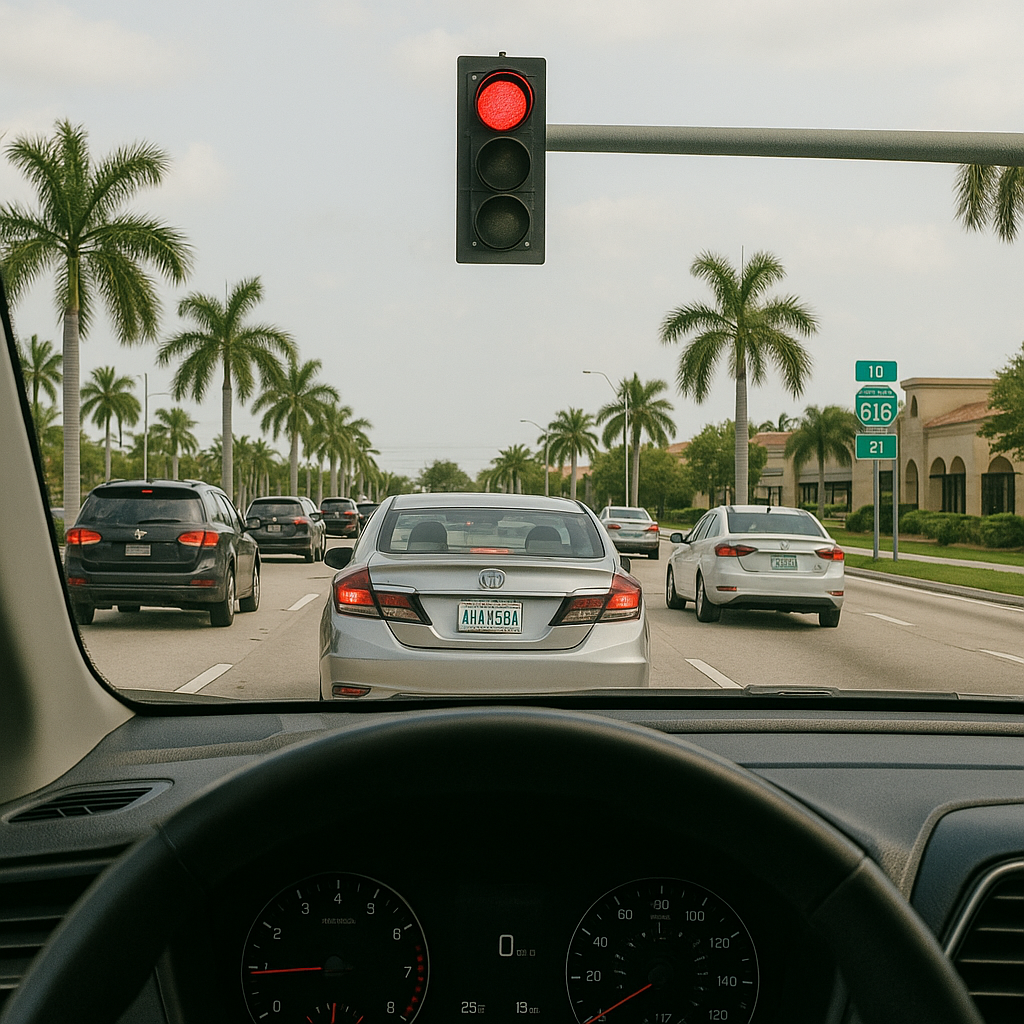
Red light accidents rank among the most dangerous and common collisions on Florida roads, often resulting in severe injuries due to high-speed side impacts. When drivers run red lights and cause crashes, liability questions typically seem straightforward. However, determining fault can become complicated when multiple factors contribute to the collision.
As January brings renewed commuting routines after the holiday season, intersection accidents increase throughout South Florida. Drivers returning to regular work schedules, combined with snowbird traffic and tourist activity, create heightened risks at busy intersections throughout Boca Raton, Wellington, Delray Beach, and Palm Beach County.
At our South Florida auto accident law firm, our 30+ years of experience includes countless red light accident cases where we’ve helped victims recover compensation from negligent drivers who violated traffic signals.
Florida’s Red Light Laws
Florida law requires drivers to stop at red traffic signals and remain stopped until the light turns green. Running a red light constitutes a clear traffic violation that typically establishes negligence in accident cases.
Right Turn on Red Exceptions:
Florida allows right turns on red after coming to a complete stop and yielding to traffic and pedestrians, unless signs prohibit such turns. Drivers who fail to stop completely before turning, or who turn without yielding to crossing traffic, violate traffic laws and can be held liable for resulting accidents.
Yellow Light Requirements:
Yellow lights signal that the light is about to turn red. Drivers who can safely stop before the intersection must do so. However, drivers who have already entered the intersection or cannot stop safely may proceed through yellow lights without violating traffic laws. Disputes often arise about whether drivers could have stopped safely before the light turned red.
Common Red Light Accident Scenarios
Several typical situations create red light collision liability questions that require legal analysis.
Straight-Through Red Light Violations:
The most clear-cut scenario involves drivers who simply run red lights and strike vehicles with green lights. These cases typically establish driver liability with minimal dispute, though insurance companies still sometimes argue that their insured entered on yellow or that the other driver had the opportunity to avoid the collision.
Left Turn Red Light Accidents:
Drivers making left turns on green must yield to oncoming traffic. When oncoming drivers run red lights and strike turning vehicles, liability can become disputed. The turning driver’s insurance may argue the turn was made unsafely, while the straight-through driver’s insurer claims their insured had a yellow light.
Intersection Clearing Accidents:
Drivers who enter intersections on yellow or green lights to make left turns must clear the intersection when the light changes. If these drivers remain in the intersection too long and collide with cross-traffic that now has a green light, fault determination requires analyzing when each driver entered the intersection.
Red Light Camera Complications:
Red light cameras at many South Florida intersections create evidence of violations, but camera timing and coverage don’t capture all intersection activity. According to the Insurance Institute for Highway Safety, red light cameras reduce certain types of crashes, but legal challenges question their accuracy and implementation. Relying solely on camera evidence without thorough investigation can miss important liability factors.
Proving Fault in Red Light Accidents
Establishing liability in red light collisions requires gathering comprehensive evidence that demonstrates which driver violated traffic laws.
Critical Evidence Sources:
Traffic camera footage from red light cameras or intersection surveillance provides objective evidence of light status and vehicle positions. Witness statements from other drivers or pedestrians who observed the collision offer independent accounts of what occurred. Damage patterns on vehicles reveal impact angles and speeds that help reconstruct the accident sequence.
Police reports document officer observations, driver statements, and any traffic citations issued at the scene. Officers typically issue citations to drivers who clearly ran red lights, creating strong evidence of fault. However, officers don’t always witness accidents and sometimes cannot determine which driver violated the signal.
Accident Reconstruction:
Complex red light accidents may require professional accident reconstruction experts who analyze physical evidence, calculate vehicle speeds, and determine when each driver entered the intersection. These technical analyses become crucial when both drivers claim they had green or yellow lights.
Florida’s Comparative Negligence in Red Light Cases
Even clear red light violations don’t always result in 100% fault allocation to the violating driver. Florida’s comparative negligence system allows fault to be distributed between drivers based on their respective contributions to the accident.
Defensive Driving Expectations:
Drivers with green lights still must exercise reasonable care and watch for potential red light runners. If evidence shows a driver with a green light could have seen and avoided a red light runner but failed to brake or take evasive action, that driver may bear partial fault for failing to avoid a preventable collision.
This doesn’t mean green light drivers must assume all cross-traffic will run lights. Rather, courts consider whether obvious red light violations were visible and avoidable with reasonable attention and reaction time.
Injuries Common in Red Light Accidents
Red light collisions frequently cause serious injuries due to high-speed impacts and limited vehicle protection at strike points.
T-Bone Impact Injuries:
Side-impact collisions typical in red light accidents expose occupants to severe injury risks. Vehicles provide less protection at doors and side panels compared to front and rear crumple zones. Common injuries include traumatic brain injuries from head strikes against windows and pillars, broken ribs and internal organ damage from door intrusions, and spinal cord injuries from lateral impact forces.
Delayed Injury Symptoms:
Adrenaline and shock often mask injury symptoms immediately after accidents. Victims may feel relatively fine at the scene only to experience serious pain, headaches, or other symptoms hours or days later. Seeking prompt medical evaluation protects both your health and your legal claim by establishing immediate injury documentation.
What to Do After a Red Light Accident
Taking proper steps after red light collisions protects your legal rights and strengthens potential injury claims.
Call police and insist on a complete accident report. Officer observations about traffic signals, vehicle positions, and driver statements provide crucial evidence. Request that officers note traffic signal status and any witness accounts of which driver had the right of way.
Take photographs showing final vehicle positions, intersection layout, traffic signals, and all vehicle damage. Note which direction each vehicle was traveling and the traffic signal each driver faced. Witness contact information becomes vital since many red light accident witnesses leave before police arrive.
Seek immediate medical attention even for apparently minor injuries. Tell medical providers about all symptoms and pain, as documentation created soon after accidents establishes injury causation and severity.
When to Contact a Florida Car Accident Lawyer
Several red light accident situations warrant legal consultation to protect your interests and maximize compensation.
Serious injuries requiring extensive medical treatment justify attorney involvement to ensure full compensation for medical expenses, lost wages, and pain and suffering. When the other driver’s insurance disputes fault or claims you could have avoided the accident despite having a green light, experienced representation becomes essential.
Red light accidents resulting in permanent disabilities, scarring, or chronic pain require careful damage calculation and aggressive negotiation to achieve fair settlements. Insurance companies typically offer inadequate initial settlements in serious injury cases, hoping victims accept quickly without understanding their claims’ true value.
Frequently Asked Questions
What if both drivers claim they had a green light? Investigation of physical evidence, witness statements, and traffic signal timing helps establish which driver actually had the right of way.
Can I recover compensation if I was partially at fault? Yes, Florida’s comparative negligence allows recovery if you were 50% or less at fault, though your compensation is reduced by your fault percentage.
What if the other driver got a red light camera ticket? Camera citations provide helpful evidence but don’t automatically prove liability in injury claims, which require separate investigation.
How long do I have to file a red light accident claim? Florida’s statute of limitations allows four years for personal injury claims, though prompt action preserves evidence and strengthens cases.
Protecting Your Rights After Red Light Accidents
Red light accidents cause serious injuries that deserve full compensation from drivers who violate traffic signals. Understanding liability principles, evidence requirements, and your legal rights helps you navigate insurance claims and potential litigation effectively.
As January brings increased traffic throughout South Florida with returning commuters and peak snowbird activity, intersection accident risks rise significantly. Defensive driving and awareness at traffic signals help prevent collisions, but when red light runners cause accidents, you need experienced legal representation to protect your interests.
If you’ve been injured in a red light accident in Boca Raton, Wellington, Delray Beach, or anywhere in Palm Beach or Broward Counties, contact Silver Injury Law for a free consultation. Our team understands red light accident liability and fights for maximum compensation from negligent drivers.
Remember: there’s no obligation for our consultation, and we only get paid when we successfully recover compensation for your injuries. Call (561) 279-3911 to speak with an attorney who will protect your rights.